
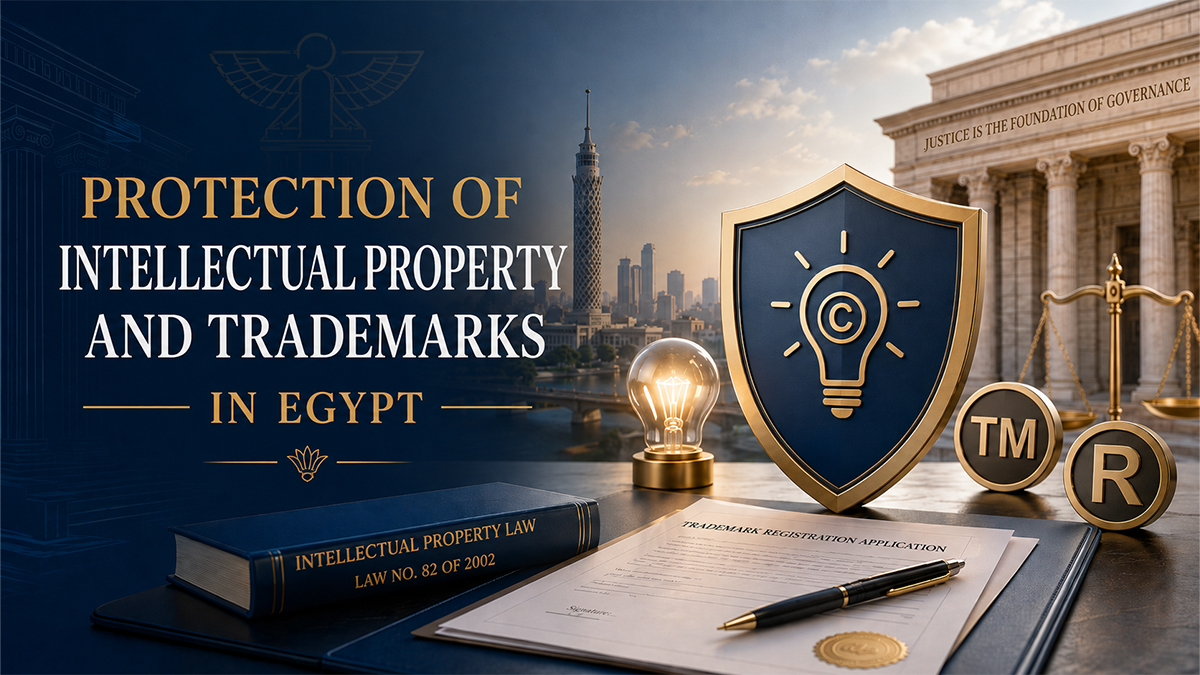
Intellectual property rights have become among the most valuable legal and commercial assets for companies, entrepreneurs, creators, and investors. In today’s highly competitive market, a trademark is no longer just a name or a logo; it is a business identity, a reputation, and a legal asset that distinguishes products and services from competitors.
In Egypt, intellectual property protection is primarily regulated by Law No. 82 of 2002 on the Protection of Intellectual Property Rights, which covers several areas, including trademarks, patents, copyrights, industrial designs, and other forms of legal protection. This law remains the main legislative framework governing intellectual property rights in Egypt.
For this reason, proper legal guidance is essential from the early stages of selecting a brand name or logo until registration, enforcement, licensing, or litigation.
What Is Intellectual Property?
Intellectual property refers to legal rights granted over creations of the mind, whether commercial, industrial, literary, artistic, or technical. These rights allow their owners to control, use, license, transfer, and legally protect their creations against unauthorized exploitation.
- Trademarks.
- Trade names and logos.
- Patents.
- Industrial designs.
- Copyrights and related rights.
- Confidential information and trade secrets.
These rights give their owners the legal authority to prevent others from copying, using, or exploiting protected assets without permission.
What Is a Trademark?
A trademark is any sign capable of distinguishing goods or services from those of others. It may consist of a word, name, logo, symbol, drawing, color combination, device, or any distinctive visual element.
For example, a trademark may be a company name, a restaurant logo, a factory mark, the name of a mobile application, or a distinctive sign used for a consulting or professional service.
A trademark helps consumers identify the commercial source of a product or service. It also protects the reputation of a business and prevents confusion in the market.
Why Trademark Registration Matters in Egypt
Although some businesses use trademarks without registration, official registration remains the strongest method of legal protection. Trademark registration creates a clear legal position and helps the owner prove ownership in the event of a dispute.
Trademark registration is important because it helps to:
1. Prove Legal Ownership
A registered trademark provides strong evidence that the applicant owns the mark for the registered goods or services.
2. Prevent Unauthorized Use
The owner of a registered trademark can take legal action against third parties using an identical or confusingly similar mark.
3. Protect Business Reputation
A trademark is closely connected to quality, goodwill, and customer trust. Unauthorized use may damage the reputation of the original owner.
4. Increase Business Value
A registered trademark may become a valuable intangible asset. It may be licensed, assigned, or commercially evaluated.
5. Support Business Expansion
Businesses planning to expand locally or internationally should protect their trademarks early to avoid future disputes.
Legal Framework for Trademark Protection in Egypt
Trademark protection in Egypt is governed by the Egyptian Intellectual Property Rights Law No. 82 of 2002 and its Executive Regulations. The law regulates registration requirements, examination, publication, opposition, enforcement, and penalties for infringement.
The Executive Regulations provide procedural details related to filing, examination, publication, objections, and other practical steps.
Trademark applications are examined by the competent Egyptian authorities according to the applicable legal rules. Egypt has also been developing its intellectual property services and electronic systems in recent years.
Requirements for Trademark Registration
For a trademark to be accepted for registration, it must generally satisfy several legal and practical requirements:
Distinctiveness
The mark must be capable of distinguishing the relevant goods or services from others in the market.
Compliance with Public Order and Morality
A mark that violates public order, public morals, or applicable legal restrictions may be rejected.
No Conflict with Earlier Marks
A trademark may be refused if it is identical or confusingly similar to a prior registered or pending mark in the same or related class.
No Misleading Information
A mark must not mislead the public regarding the origin, nature, quality, or characteristics of the goods or services.
Proper Classification
The application must identify the correct class or classes of goods or services.
Trademark Registration Procedure in Egypt
Trademark registration usually passes through several stages:
1. Preliminary Trademark Search
Before filing, it is advisable to conduct a trademark search to identify identical or similar marks. This reduces the risk of refusal or future disputes.
2. Preparing Required Documents
Documents may vary depending on whether the applicant is an individual or a company. They commonly include applicant details, a representation of the mark, commercial registration documents where applicable, and a power of attorney if filed through a lawyer or agent.
3. Filing the Application
The application is submitted to the competent authority with the trademark details, class information, and list of goods or services.
4. Examination
The authority examines the application to verify compliance with formal and substantive requirements.
5. Publication and Opposition
If accepted, the trademark is published according to the required procedure. Third parties may file an opposition within the legal period if they have valid grounds.
6. Final Registration
If no opposition is filed, or if the opposition is resolved in favor of the applicant, the remaining steps are completed and the registration certificate is issued.
Forms of Trademark Infringement
Trademark infringements are not limited to direct imitation only; they may occur in various forms, including:
- Using an identical trademark without permission.
- Using a similar trademark in a way that misleads the public.
- Imitating a trademark logo or design.
- Selling products bearing a counterfeit trademark.
- Registering a domain name similar to the trademark with the aim of exploiting its reputation.
- Using the trademark in advertisements or on social media platforms without authorization.
- Imitating the packaging design or product presentation in a way that causes confusion.
In such cases, the trademark owner has the right to take appropriate legal action to protect their rights, stop the infringement, and claim compensation where damage is established.
Legal Protection Against Trademark Imitation
When a trademark infringement occurs, it is not sufficient to rely solely on an amicable warning. Instead, a structured legal approach should be taken. The appropriate procedure may vary depending on the nature and scale of the infringement, as well as the available evidence.
Legal protection measures may include:
Legal Notice
Sending an official legal notice to the infringer, requiring them to stop using the trademark, remove the content, or refrain from selling counterfeit products.
Taking Judicial Action
The trademark owner may resort to the competent court to request the cessation of the infringement and claim compensation for the damages suffered.
Criminal proceedings where the elements of the offence are established
In certain cases involving imitation, forgery, or the intentional sale of products bearing a counterfeit trademark, criminal liability may arise under the law.
Seizure of Counterfeit Products
Certain cases may require urgent measures to prove the infringement or to seize the infringing products or documents.
Claiming Compensation
If the infringement results in material, moral, or commercial damage, the rights holder may claim appropriate compensation.
Common Mistakes When Dealing with Trademarks
Many business owners make mistakes that may put their trademarks at risk, most notably:
- Using a trademark before ensuring its legal availability.
- Delaying trademark registration despite using it in the market.
- Registering the trademark under an inappropriate class.
- Relying only on the logo design without protecting the trade name.
- Ignoring the monitoring of similar trademarks that appear in the market.
- Failing to take prompt action upon discovering imitation.
- Using a trade name similar to a well-known trademark without conducting a legal review.
These mistakes may lead to the refusal of registration, the loss of protection opportunities, or involvement in costly disputes that could have been avoided from the outset.
The Role of Khaled Mahana Law Office in Intellectual Property and Trademark Cases
Khaled Mahana Law Office provides comprehensive legal support in intellectual property and trademark matters, whether for individuals, companies, startups, or commercial institutions.
Legal services in this area include:
- Providing legal consultations regarding the selection of a trademark.
- Conducting a preliminary legal examination and search before registration.
- Preparing and reviewing trademark registration documents.
- Following up on registration procedures before the competent authorities.
- Handling objections to trademark applications.
- Filing lawsuits to stop infringement and claim compensation.
- Representing clients in disputes involving imitation or unauthorized use.
- Drafting trademark licensing or assignment agreements.
- Providing legal support to companies in protecting their commercial identity.
The office aims to help clients protect their intangible assets, preserve the value of their trademarks, and prevent any unlawful exploitation that may harm their reputation or commercial interests.
When Do You Need an Intellectual Property Lawyer?
You may need to seek the assistance of a lawyer specialized in intellectual property in several cases, including:
- When launching a new project or brand.
- Before designing a logo or choosing a trade name.
- When wishing to register a trademark.
- If you receive an objection to your trademark.
- If you discover that another person is using a similar trademark.
- When counterfeit products exist in the market.
- When expanding the business or opening new branches.
- When signing franchise agreements or trademark licensing agreements.
Early legal action protects you from disputes and gives you a stronger position when defending your rights.
Protecting intellectual property rights and trademarks is no longer a legal luxury; it has become a necessity for every entrepreneur, company, or commercial activity seeking to build a strong and stable name in the market. A trademark is the face of the business, and protecting it means protecting trust, reputation, and investment.
Through proper legal registration and careful monitoring of any attempts at imitation or infringement, the rights holder can preserve their commercial position and prevent others from exploiting their success or misleading their customers.
Therefore, Khaled Mahana Law Office is committed to providing specialized legal services in the registration and protection of trademarks and intellectual property rights, ensuring clients receive effective legal protection and maintain a strong position before the competent authorities and courts.